
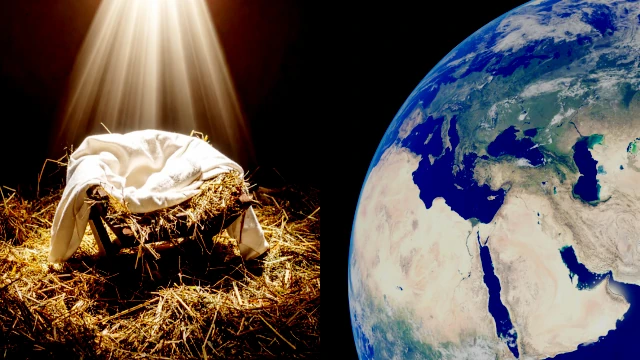
 Epiphany is a season of revelation. The word itself means “to make manifest” meaning to show clearly what was hidden. In the Epiphany story, God reveals: the salvation promised to The Holy Land is also for all, the foreigners, and the outsiders.
Epiphany Themes: Light, Power, Courage and Holy Disruption
1. God’s Light Shines for All People: The Magi are Gentiles, and foreign scholars—outsiders. Their presence fulfills the ancient promise that God’s salvation would reach all. “Nations will come to your light, and kings to the brightness of your dawn.” (Isaiah 60:3, NIV) Epiphany reminds us that God’s truth is not the possession of any one people, culture, or nation. Christ’s light shines in unexpected places and draws in those far from centres of religious or political power.
2. Earthly Power Is Exposed and Threatened: While the Magi respond with wonder and worship, Herod responds with fear and violence. Epiphany exposes a sharp contrast: worldly power clings to control, while God’s power arrives in vulnerability. “When King Herod heard this he was disturbed, and all Jerusalem with him.” (Matthew 2:3, NIV) The story makes clear that Jesus’ kingship threatens systems built on domination, exclusion, and fear.
3. Faith Requires Obedience and Courage: Warned in a dream, the Magi refuse to cooperate with Herod and return home by another road. “Having been warned in a dream not to go back to Herod, they returned to their country by another route.” (Matthew 2:12, NIV) Epiphany faith is not passive. It requires discernment, moral courage, and a willingness to resist unjust authority.
4. Jesus the Refugee, Fleeing Violence and State Power: Epiphany does not end with gold and incense. It quickly turns toward danger, displacement, and fear. After the Magi leave, Joseph is warned in a dream, “Get up,” he said, “take the child and his mother and escape to Egypt. Stay there until I tell you, for Herod is going to search for the child to kill him.” (Matthew 2:13, NIV) Jesus becomes a refugee. Carried across borders for safety. Dependent on the mercy of another land. Vulnerable to the violence of a ruler determined to preserve his power at any cost. “So he got up, took the child and his mother during the night and left for Egypt.” (Matthew 2:14, NIV) This is not a side note in the Gospel but is central. Our Savior knows displacement from the inside. When we speak today about immigrants, refugees, and asylum seekers fleeing war, persecution, climate disaster, or poverty, we are not speaking about an abstract issue. We are speaking about a story that Jesus himself lived.
Light for the Nations, Hope for the Stranger
Across the world and within our own communities, immigrants and refugees face suspicion, dehumanization, and political scapegoating. Like Herod, modern systems often respond to vulnerability with fear and exclusion rather than compassion. Epiphany asks us “Do we see Christ in the stranger or do we see a threat to our comfort and power?” Jesus later makes this connection unmistakably clear… “For I was hungry and gave me something to eat, I was thirsty and gave me something to drink, I was a stranger and you invited me in” (Matthew 25:35, NIV) To welcome the immigrant is not merely a political stance; it is a profoundly Christian act of recognition. Christ is revealed and made manifest in the outsider.
Scripture leaves no ambiguity about God’s call to love the stranger. This call to action finds its roots within the Old Testament and then is reaffirmed within the epiphany story carrying through to The Cross. “Do not oppress a foreigner; you yourselves know how it feels to be foreigners, because you were foreigners in Egypt.” (Exodus 23:9, NIV) “The foreigner residing among you must be treated as your native-born. Love them as yourself.” (Leviticus 19:34, NIV) “Love those who are foreigners, for you yourselves were foreigners in Egypt.” (Deuteronomy 10:19, NIV)
Epiphany calls Christians not only to believe differently, but to live differently. We are called to Advocate for just and compassionate immigration policies, Support refugee resettlement and sponsorship efforts, Speak out against language and systems that dehumanize newcomers, Offer hospitality, friendship, and tangible care in our communities… “Do not forget to show hospitality to strangers, for by so doing some people have shown hospitality to angels without knowing it.” (Hebrews 13:2, NIV)
At the end of the Epiphany story, the Magi go home “by another route.” Encountering Christ changes their direction and it should change ours. In this season of Epiphany, we are called to walk another road… beyond fear beyond borders beyond comfort
May we recognize Christ in The Immigrant, The Refugee, and The Outsider.“The true light that gives light to everyone was coming into the world.” (John 1:9, NIV)
Amen.