
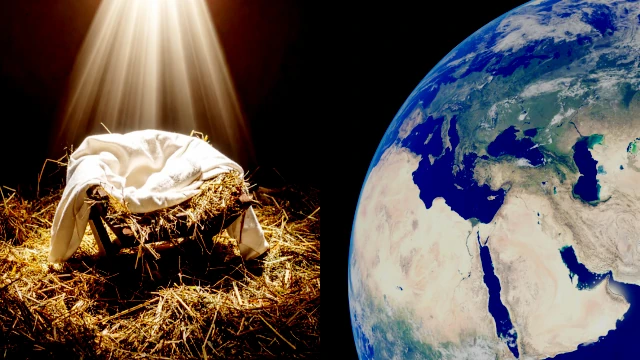
 Epiphany is a cornerstone of the Christian calendar. Its significance varies across religions, resonating in unique ways. At its heart, for Christians, Epiphany celebrates the “manifestation” of the moment the divine is revealed to humanity. It commemorates; the visit of the Magi, Jesus’s Baptism, and the miracle at Cana, as an “unveiling” with direction and purpose. A path of daily action shared by all.
 The Magi revelation of Christ, signals a message to all, emphasizing the “Light of the World” (John 8:12), the guiding Star of Bethlehem as a metaphor for faith. Focus is taken with The Magi (Gentiles from the East following the light and then departing by a different path) that begins Jesus’ impact in Matthew 8:11: “Many will come from the east and the west, and will take their places at the feast with Abraham, Isaac and Jacob.” Pointing to Gospel fulfillment, not for one group alone but for all humanity. Where God’s family is defined by faith, not by genealogy, borders or ‘walls of hostility’.
Jesus’s Baptism, as a public declaration, “Anyone who has seen me has seen the Father” (John 14:9). “This is my Son, whom I love; with him I am well pleased” (Matthew 3:17). A place in time, for adapting, to more than just survival. Jesus, a non violent, authority questioning revolutionary Jew, avoided greed and envy, in leading the way for each of us to work in cooperation with others.
The miracle at Cana was more than the act of turning water into wine as a favor to the host. It was “first of his signs” through which he “revealed his glory” (John 2:11). A sign of coming abundance and joy where there was once scarcity.
For Christians the season of Epiphany turns toward, transformation and mission. “Go and Do Likewise.” As the Magi “bowed down and worshiped,” we are called to give our best… our “gold, frankincense, and myrrh” to help God’s work. Jesus was named “Son” at his baptism, just as we find our true identity as children of God through him. Like the Magi “returned by another way” Christ changes our direction, avoiding going back to the “Herods” of an old life.
The universal impact of Epiphany lies in search. Whether it is the Magi following a star or a seeker following a quiet inner voice, Epiphany reminds us that spiritual life is not static. A message that the Divine is actively trying to be “seen”, often in unexpected places or people, all in the face of our being given the ability to think and question. Epiphany offers the spiritual hope that no matter how difficult, a “light” exists to guide us toward a deeper understanding of our purpose and connections.
While other religions may not observe Epiphany, as a holy day, the themes of Epiphany surface there as well. The concept of revelation is central to the Jewish faith. While Jews do not recognize the divinity of Jesus, the “Epiphany” of the Magi echoes the tradition of nations coming to recognize God. The symbolism of light flows into Hanukkah with the divine presence manifested through a miraculous flame. Muslims revere Jesus (Isa) as a major prophet and acknowledge his miraculous birth. Islam strictly rejects the idea of God becoming incarnate, however the “manifestation” of divine signs is a Quranic theme. The journey of the Magi is similar to the Hajj, where believers travel great distances to seek a closer encounter with the Divine. In Buddhism or Hinduism, an “epiphany” is akin to enlightenment or Darshan—the auspicious sight of a deity or holy person that brings a spiritual blessing to the viewer.
There is a path for all, with Epiphany Turning On Daily Action.